Investing basics
How to tell if a business actually growing?
Learn how experienced investors judge whether a business is genuinely becoming more valuable over time.
A healthy business growing steadily over time with revenue, profit and customers increasing year after year.
Imagine you had saved enough money to buy a small local business.
Not a share on a screen. Not a ticker symbol. A real business with staff, customers, suppliers, rent, bills and money coming through the till.
Two opportunities land on your desk.
The first is a family-run bakery that has quietly become the busiest in town. Five years ago it sold a few hundred loaves a day. Today it sells nearly twice as many. It has added a small café area, hired more staff and built a loyal group of customers who come back every week. The owner has never appeared on television, never gone viral and never described the business as disruptive. It simply gets a little better every year.
The second bakery looks similar from the outside, but the numbers tell a different story. Sales have barely moved in five years. Costs are rising. Profits are shrinking. Every year the owner talks confidently about expansion, new menus and exciting plans, but the business itself never seems to become stronger.
Which one would you rather own?
Most people answer that question quickly. They would rather own the business that is growing steadily, making more money and becoming more valuable over time.
Yet when people invest in the stock market, they often forget to ask the same question. They focus on whether the share price has fallen, whether the P/E ratio looks cheap, or whether the dividend yield is attractive. Those things matter, but they should not come first.
The first question should be simpler.
Is this business becoming more valuable every year?
That question sits underneath much of what great investors have done for decades.
Peter Lynch looked for real businesses that were quietly expanding long before the wider market noticed. Robbie Burns often looks for companies that keep compounding while everyone else is distracted by fashionable stories. Warren Buffett has built a career around owning businesses that can become stronger over many years, not just next quarter.
Their styles are different, but the principle is similar.
A growing business gives time something useful to work with.
The market often distracts you
One of the hardest parts of investing is separating the business from the share price.
Open almost any investing app and the share price is the first thing you see. It moves up and down constantly. Financial news then tries to explain every movement as if it must mean something important. One day a company is loved. The next day it is ignored. A week later it is apparently a bargain or a disaster.
Most of that noise tells you more about investor mood than business quality.
A company's share price can fall because interest rates rise, markets become nervous, a large fund sells, or investors simply lose patience. None of that means the underlying business has changed overnight.
Go back to the bakery.
If someone offered you £900,000 for it on Monday and £820,000 on Tuesday, would the ovens suddenly stop working? Would loyal customers disappear? Would the staff forget how to bake bread?
Of course not.
The business has not changed just because someone's opinion of it changed. Public companies work in the same way. The market changes its opinion every day, but the business itself usually changes much more slowly.
That is why Peter Lynch often reminded investors that a share is not just a price on a screen. It is part ownership of a real company. Real companies sell products, serve customers, employ people, pay bills and try to earn profits.
Once you start thinking like a business owner rather than a price watcher, investing becomes much clearer.
DeepSleep Principle
Don't start by asking whether the share price is growing.
Start by asking whether the business is growing.
If the business keeps becoming stronger, the share price has a much better chance of following over the long term.
Why growth matters
A business becomes more valuable by creating more economic value.
That sounds obvious, but it is easy to forget when markets are moving quickly. A company that earns £50 million today and £100 million five years from now is usually worth more than it used to be. It has more profit, more cash, more options and often more resilience.
Growth gives a company choices. It can invest in new products, open new markets, improve technology, hire better people, reduce debt, increase dividends or buy back shares. A business that is growing profitably has room to make decisions.
A stagnant business has fewer options.
If costs rise but sales do not, margins get squeezed. If competitors improve but the business stands still, customers drift away. If management keeps promising a better future but the numbers never improve, investors eventually lose trust.
This is why experienced investors rarely want growth for excitement alone. They want growth because profitable growth increases the value of the business.
There is a big difference between a company that looks busy and a company that is genuinely becoming stronger.
Our bakery could open five new shops in a year and grab attention locally. But if each new shop loses money, the expansion is not creating value. It is just creating activity. The better business might open one new shop, do it carefully, keep profits rising and strengthen the brand over time.
A growing business has choices. A shrinking business has excuses.
Growth is not just about getting bigger
One of the biggest mistakes new investors make is assuming that bigger automatically means better.
It does not.
A company can increase revenue dramatically while becoming a worse business. The top line can look exciting while the economics underneath quietly deteriorate.
Imagine our bakery decides to slash prices to win market share. Customers flood in. Sales rise sharply. The local paper writes a glowing article about its rapid growth. On the surface, it looks like a success.
But the owner is now making far less profit on every loaf. Flour costs have risen. Energy bills are higher. Extra staff are needed to handle demand. At the end of the month, the business is busier than ever but the owner takes home less money.
That is not quality growth.
That is harder work for weaker economics.
Public companies can fall into the same trap. Retailers can grow by discounting too heavily. Software companies can grow by spending enormous amounts on marketing. Housebuilders can grow by taking on too much debt. Acquisition-led businesses can grow by buying other companies while hiding problems inside the combined numbers.
The headline might say revenue is up.
The better question is whether the business is stronger because of it.
Revenue tells one story. Profit tells another.
When most people first start investing, revenue is often the first number they notice. That makes sense. If a company is selling more, it feels like progress.
But sales do not pay shareholders. Profits do.
Revenue is the total amount of money coming into the business. Profit is what remains after paying suppliers, wages, rent, energy bills, interest, tax and everything else required to keep the company running.
The two are connected, but they are not the same.
A coffee shop might increase sales from £800,000 to £1 million in a year. At first glance that looks excellent. But if milk, coffee beans, wages and electricity all rise at the same time, profit might fall from £140,000 to £110,000.
The business is selling more, but keeping less.
That is why professional investors compare revenue growth with profit growth. If both are moving in the same direction, it is usually a healthy sign. If revenue is rising but profits are flat or falling, you need to understand why.
Sometimes there is a good explanation. A company may be investing heavily for future growth, opening new sites or launching new products. But sometimes the explanation is less attractive. The company might be cutting prices, losing pricing power or spending more just to stand still.
This is where the annual report becomes useful. Management presentations will usually tell you why everything is exciting. The income statement tells you what actually happened.
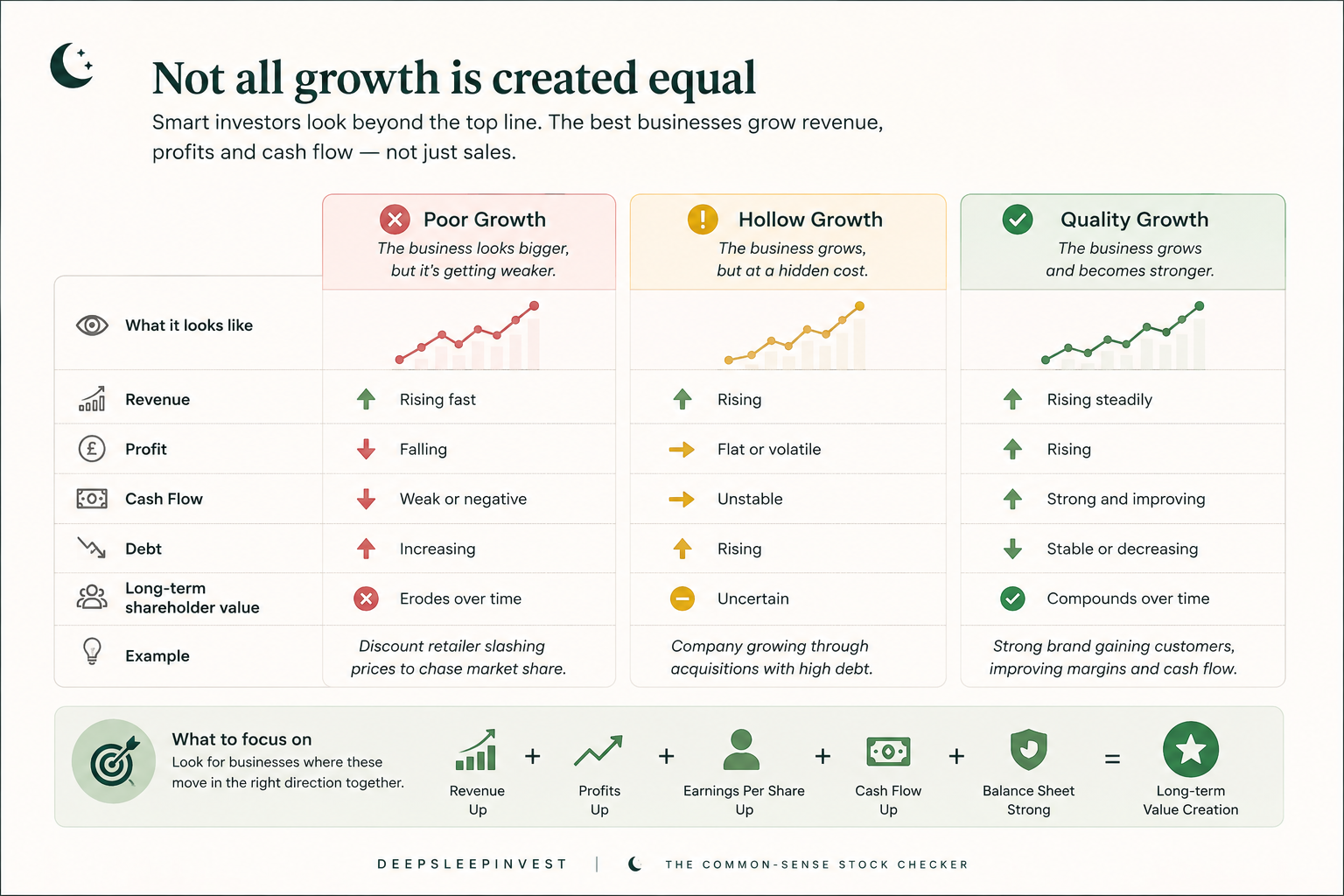
Key idea: The best businesses do not just grow sales. They grow revenue, profits, earnings and cash flow together while keeping debt under control.
Healthy growth
| Year | Revenue | Pre-tax Profit |
|---|---|---|
| 2021 | £420m | £41m |
| 2022 | £465m | £49m |
| 2023 | £515m | £57m |
| 2024 | £568m | £65m |
This is the kind of pattern investors like to see.
The company is not simply getting bigger. It is keeping more money as it grows. Revenue is rising, profit is rising and the business appears to be moving in the right direction.
Consistency beats excitement
It is easy to become excited by spectacular growth.
A company reports revenue up 70%. Profits double. Sales triple. The share price jumps and suddenly everyone is talking about it.
Sometimes those numbers are genuinely impressive. A great business can have breakthrough years. But experienced investors know that one extraordinary year does not automatically make a great long-term investment.
The better question is whether the growth can continue.
Many of history's strongest investments did not look spectacular at the time. They were not always the fastest growers in the market. They were often businesses that quietly became a little larger, a little more profitable and a little more valuable every year.
That kind of growth rarely makes headlines, but it can be incredibly powerful.
A company that grows profits by 12% a year will almost triple those profits over ten years. That is the magic of compounding. It does not require drama. It requires patience, discipline and a business that keeps executing.
This is why Robbie Burns often talks about boring compounders with such enthusiasm. A boring company that keeps increasing profits can be far more attractive than an exciting company that produces one brilliant year followed by disappointment.
Buffett thinks in a similar way. He is not usually trying to guess which company will grow fastest next month. He wants businesses that can keep earning more money many years from now.
The market loves exciting stories. Long-term investors love predictable progress.
The five-year question
When researching a company, it helps to step away from the latest news.
Forget tomorrow's share price. Forget next quarter's update. Forget what people are saying on social media.
Ask a more useful question.
Is this business clearly stronger than it was five years ago?
That one question can reveal a lot. A stronger business usually has higher revenue, higher profits, better cash generation, a larger customer base, better products, stronger market positions or improved earnings per share.
It does not need to be perfect. Real businesses have difficult years. Costs rise. Customers delay spending. Economies slow. Competitors make life harder. One weak year does not automatically ruin an investment case.
What matters is the direction of travel.
If the long-term trend shows that the business is becoming larger, more profitable and more resilient, you are probably looking at something worth studying further. If the company has spent five years promising improvement while the numbers move sideways or backwards, you should be much more careful.
The five-year test
Before buying a share, ask yourself:
Would I be happy to own the whole business if I could not sell it for five years?
If the answer is no, you may be relying too much on the share price and not enough on the quality of the company.
What Peter Lynch looked for
Peter Lynch believed ordinary investors could spot great businesses before professional analysts became interested.
His point was not that you should buy every company you see in everyday life. It was that real-world observations can give you clues.
If your favourite coffee shop is suddenly packed every morning, that might be interesting. If a retailer opens in your town and everyone seems to be shopping there, that might be worth noticing. If a product becomes part of everyday conversation, there may be a business story behind it.
But Lynch never stopped at the story.
He wanted the numbers to confirm it.
A busy shop is encouraging. A busy shop that turns into rising revenue, rising profits and rising earnings per share is much more powerful.
This is where many investors go wrong. They fall in love with a product and assume the share must be a good investment. The product might be excellent, but the company still has to make money, control costs and grow sensibly.
Growth without evidence is just optimism.
Growth backed by improving financial results is something very different.
Peter Lynch's question
Is the company actually getting better, or am I just buying into a good story?
The annual report should support the narrative, not contradict it.
Robbie Burns and the power of quiet compounders
If you've read The Naked Trader, you'll know Robbie Burns has never been particularly interested in chasing whatever happens to be fashionable. He has always preferred companies that quietly get on with the job of making more money year after year.
Many of the best-performing investments don't look spectacular at first glance.
They rarely dominate financial news. They don't promise to change the world overnight and they certainly don't produce dramatic headlines every quarter.
Instead, they do something much more valuable.
They improve.
Revenue edges higher.
Profits edge higher.
Cash generation improves.
Management reinvests sensibly.
Then they repeat the process next year.
And the year after that.
It doesn't sound exciting, but that's exactly why many investors overlook these businesses. Markets naturally gravitate towards exciting stories, while dependable compounders quietly continue creating value in the background.
Eventually the market catches up.
That's one of the reasons Robbie Burns often talks about letting your winners run. If the business continues becoming stronger, selling simply because the share price has risen can mean walking away from years of future compounding.
Buffett doesn't buy quarters. He buys decades.
Warren Buffett approaches growth from a slightly different angle.
He rarely asks what a company will earn next year.
Instead, he asks whether he can make a sensible estimate of what the business might look like ten or twenty years into the future.
That changes everything.
Rather than searching for the fastest-growing business today, Buffett looks for businesses that are likely to keep earning more money long after today's headlines have disappeared.
Think about some of Berkshire Hathaway's largest investments over the years.
Insurance companies.
Consumer brands.
Payment networks.
Railroads.
None of them look particularly glamorous, but they all provide products and services people are likely to need for decades.
The individual products may change.
Technology will evolve.
Consumer habits will shift.
But the underlying demand remains remarkably resilient.
That makes future growth far easier to predict.
This idea is often referred to as having a durable competitive advantage, or what Buffett famously calls an economic moat. Companies with strong brands, loyal customers, pricing power or high barriers to entry often find it easier to keep growing over long periods because competitors struggle to take market share away from them.
The best investment isn't always the company growing fastest today. It's often the company most likely to keep growing ten years from now.
When growth isn't actually growth
One of the easiest traps for investors is assuming every increase in revenue is good news.
Sometimes companies appear to be growing while the underlying business is actually becoming weaker.
Imagine a retailer opens twenty new stores in a single year.
Revenue jumps by 30%.
Investors celebrate.
Management proudly announces record sales.
Then you dig a little deeper.
Every new store is making very little profit.
The company has borrowed heavily to fund the expansion.
Cash flow has weakened.
Debt has increased.
Margins have fallen.
Has the business really improved?
Probably not.
It has become larger, but not necessarily better.
Now imagine another company.
Revenue grows by only 8%.
Profits increase by 15%.
Cash generation improves.
Debt falls.
Management buys back a small number of shares because excess cash is available.
On paper it looks far less exciting.
As a business, it is considerably stronger.
This is why experienced investors don't simply ask "How fast is the company growing?"
They ask "Is the quality of that growth improving the business?"
The numbers that deserve your attention
Annual reports can feel intimidating when you first open them.
Hundreds of pages.
Charts.
Accounting terminology.
Corporate language.
The good news is that you don't need to understand every page to form a sensible first impression.
Start by looking at a handful of numbers over the last five years.
| Measure | Why it matters |
|---|---|
| Revenue | Are more customers buying the company's products or services? |
| Operating profit | Is the business becoming more efficient as it grows? |
| Pre-tax profit | Is overall profitability improving? |
| Earnings per share (EPS) | Is each shareholder benefiting from that growth? |
| Free cash flow | Are profits turning into real cash? |
Don't become obsessed with a single year's results.
Look for the direction of travel.
Businesses rarely improve in perfectly straight lines.
One disappointing year doesn't automatically make a company unattractive.
Likewise, one exceptional year doesn't automatically make it a wonderful investment.
Long-term trends are almost always more informative than short-term headlines.
A simple comparison
Imagine you're comparing two companies.
Company Alpha
| Year | Revenue | Profit |
|---|---|---|
| 2020 | £420m | £38m |
| 2021 | £445m | £42m |
| 2022 | £474m | £47m |
| 2023 | £508m | £53m |
| 2024 | £551m | £61m |
Nothing about these numbers is spectacular.
But that's exactly the point.
Every year the company becomes a little stronger.
Customers spend more.
Profits increase.
Management appears to be executing consistently.
Now compare that with Company Beta.
| Year | Revenue | Profit |
|---|---|---|
| 2020 | £410m | £44m |
| 2021 | £490m | £39m |
| 2022 | £570m | £28m |
| 2023 | £620m | £17m |
| 2024 | £670m | £9m |
If you only looked at revenue, Company Beta would appear to be winning comfortably.
Looking at profits tells a completely different story.
The business is selling more every year, but keeping less and less of what it earns.
That's why experienced investors never stop at the top line.
Remember
Revenue tells you how much money comes into the business.
Profit tells you how much money stays inside the business.
Growing businesses need both.
A five-minute annual report exercise
The next time you research a company, don't start by reading the chairman's letter.
Go straight to the financial highlights.
Cover the latest year's figures with your hand and look backwards.
Can you see the business becoming steadily stronger?
Has revenue generally increased?
Have profits followed?
Has earnings per share improved?
Is debt under control?
Within five minutes you'll often have a better understanding of the company than someone who has spent an hour reading financial headlines.
That's because annual reports tell you what actually happened.
News headlines usually tell you what people are talking about.
Common mistakes new investors make
Most investing mistakes don't happen because people can't understand financial statements.
They happen because attention is directed towards the wrong things.
Many investors become fascinated by exciting products, charismatic founders or dramatic share price movements while paying very little attention to whether the business itself is improving.
Others become fixated on buying companies simply because the shares have fallen sharply.
A falling share price can create opportunities.
It can also be a warning sign.
The only way to tell the difference is by understanding the business behind the price.
Companies that consistently increase revenue, profits, earnings and cash flow over many years often recover from temporary market setbacks because the underlying business continues creating value.
Businesses that fail to improve rarely have that luxury.
Growth should help you sleep better
One of the aims of DeepSleepInvest is to help you invest with confidence rather than emotion.
Understanding business growth plays a huge part in that.
When you've taken the time to understand how a company makes money and you've seen years of steady improvement in revenue, profits and cash generation, short-term market volatility becomes much less frightening.
The share price might fall next week.
Markets do that.
But if the business itself continues becoming stronger, your investment thesis may still be perfectly intact.
That's one reason Warren Buffett appears so calm during market downturns.
His confidence doesn't come from predicting tomorrow's market.
It comes from understanding the businesses he owns.
The more confidence you have in the underlying business, the less likely you are to make emotional decisions when markets become volatile.
Sleep Score takeaway
If you only remember one idea from this article, make it this.
Don't buy shares simply because they look cheap. Buy businesses that are becoming more valuable over time.
Look for companies where revenue is growing steadily.
Look for profits that grow alongside those revenues.
Look for earnings per share that trend upwards over many years.
Look for healthy cash generation and sensible levels of debt.
Above all, look for consistency.
Peter Lynch reminded investors that every share represents part ownership of a real business.
Robbie Burns showed that quietly compounding businesses often produce extraordinary long-term returns.
Warren Buffett demonstrated that time is the greatest ally of a high-quality company.
Markets will always fluctuate.
Prices will always move.
But businesses that consistently become stronger have historically given patient investors one of the greatest advantages available.
The next time you're tempted by a cheap-looking share price, pause for a moment and ask yourself a much better question.
Is the business actually growing?